Saturday, August 10, 2019

Lady's Well, Athenry 1923-1924 by Ronan Killeen

Lady's Well, Athenry (reference: Athenry Parish Heritage page)


In August 1923  supporters of the then present government (Free-State) and anti-treaty attend the pilgrimage at Lady’s Well, Athenry. Patrick Kennedy presided over the meeting of Treaty candidates was held in the afternoon. Stephen Jordan presided the Anti-Treaty gathering addressed by Mr. O’Dea. A statement made by the chairperson aroused hostility in the crowd and a tussle ensued. Some of the crowd panicked and fled the scene only to return later. The Civic Guard entered the crowd and drew their batons using them vigorously.  The disturbance was quelled and Mr. O’Dea was able to resume his speech.[1]
The above event happened after a ceasefire for the Irish Civil War was called in May 1923 conflict was still high between Treatyites  and Anti-Treatyites.
The Civic Guard was formed by the Provisional Government in February 1922 to take over the responsibility of policing the fledgling Irish Free State. It replaced the Royal Irish Constabulary (RIC) and the Irish Republican Police of 1919–22.
In the year of 1932  which was the same year of the Eucharistic Congress
there was a public meeting held at Lady's Well which  authorised a ladies committee to collect funds in Athenry  for the purpose of erecting a Memorial Cross at Lady's Well which was to be erected on 26 June 1932 for the Eucharistic congress. That same year Fr. Conroy P. P. organised times for masses for pilgrims visiting the well as visitors that arrive in Athenry at different times such as morning, evening by train and put an appeal to pilgrims to reply in his letter  via the Connacht Tribune suitable times for them.  '[2]
In August 1934 the Connacht Tribune reported that a ‘A big crowd attended arrived Tuesday evening and Wednesday morning . The Wednesday morning train was crowded with pilgrims from Connemara and the Claddagh, Galway. Some years ago an all-night vigil at the well-used to precede Lady day, very few keep the vigil visits on the evening of the 14th and 15th.’


[1] Freeman’s Journal 16/08/1923
[2] Connacht Tribune 13/08/1932

Monday, December 17, 2018

List of Publicans and Hotel Owners/Managers 1856-1936 by Ronan Killeen (Merry Christmas!)


1846[1]
Margaret Barrett, (Hotel and Posting House); Matthias Cannon; John Dunleavy; John Holleran; John Whelan.

1856[2]
Margaret Battett (Hotel and Posting House); William Brown (Railway Hotel); Bridget Cannon; John Dunleavy; John Holleran; Timothy Kinneen (Hotel); Bridget Whelan.

1870[3]
Ann Barrett; Blackhall and McDonagh; Mary Dermody; Thomas Donohue; John Dunleavy; Morgan Fahy; Ann Gunning (Hotel and Posting House); Thomas Heavy; Michael Higgins; James Joyce; Bridget Kelly; Hector McCoy; Michael Nolan; Railway Hotel and Posting House; Timothy Kinneen; James Ryan; Bridget Whelan.


1881[4]
Joseph Barrett; Blackhall and McDonagh (trading in wine spirits may not have been publicans?); Michael Broderick; James Cloonan; John S. Dillion; Patrick Dooley; Patrick Dunleavy; Morgan Fahy; Peter Joyce; Bridget Kelly; Thomas R. Kelly; Patrick Kinneen; Kinnen’s Hotel (also posting house); Timothy Kinneen; Lawerence Lardner; Bernard Nolan; Richard Nolan; Anne Kavanagh (Railway Hotel); James Ryan; Samuel Smyth; Joseph Sweeney; Bridget Whelan.

1901[5]
Maud Josephine Kennedy (Hotel Business and Proprietress) ; Michael J. Lardner; Bridget Lardner; John J. Glynn[6]; Thomas Duddy; Richard P. Nolan; Peter Ruane; Patrick Fox; Patrick J. Nolan; John P. Gill; Honoria Nolan; Michael Ruane; Matthias McDonagh; Matthew Daly.

1911[7]
Maria McMery, Hotel Mangeress, Cullairbaun; Margaret Whelan; Bourkes Lane (Burkes Lane but Bourkes in 1911 census); Bridget Lardner is not listed as a publican in 1911 census however her son Lawerence Lardner is a Publican’s Assistant; Patrick Mahon is now a publican but was a Grocer and Emigration agent in 1901 census; John Franicis Kelly, Cross street; Francis Joseph Finnerty, North Gate Street; Mary Ruane, North Gate Street; Mary Ryan, North Gate Street; Peter Ruane, Old Church street, Mary Daly, Hotel Mangeress, Iug Hotel (Ivy Hotel spelling wrong in 1901 census?); Old Church street.

1931[8] and 1936[9]
Corbett and Co., Northgate Street; Thomas Curran, The Square; M. Daly, Cross street; Patrick Duffy, The Arch; E. Durkin, Church street; Mrs. Fallon, Northgate street; P. J. Fox, Old Church street; J. Glynn’s, Old Church street; Thomas Higgins, Davis Street; Stephen Jordan, Davis street; J. F. Kelly, Cross street; M. R. C. V. S.,(see footnote below referring to M. R. C. V. S.)[10] , Church street, P. Mahon, Cross street; Patrick Mahon, Bridge street;  Mrs. Nolan, Northgate street; R. P. Nolan, Old Church street; Mrs. O’Neill, The square; D. Reynolds, Old Church street.

 ..................and also Merry Christmas all and happy new year!


[1] Slater’s directory 1846
[2] Slater’s directory 1856
[3] Slater’s Directory 1870
[4] Slater’s occupation directory 1881
[5] 1901 census
[6] J. Glynn’s but  written down as John J. Glynn on 1901 census.
[7] 1911 Census
[8] http://www.from-ireland.net/1931-trade-directory-athenry-galway/
[9]  Thom’s Directory 1936
[10] M. R. C. V. S.  = Member of the Royal College of Veterinary Surgeons in the occupation directory from 1931 but I believe this may have been a mistake as  M. R. C. V. S. dosen’t appear in the occupational directory source of Thom’s directory 1936 but the only M.R. C. V.S. refered to was a T. Kelly McDermott based in Raheen Athenry. From Thom’s Directory 1936


Tuesday, November 13, 2018

ATHENRY NEW CEMETARY 5TH JUNE 1915 CONNACHT TRIBUNE EXTRACT by Ronan Killeen


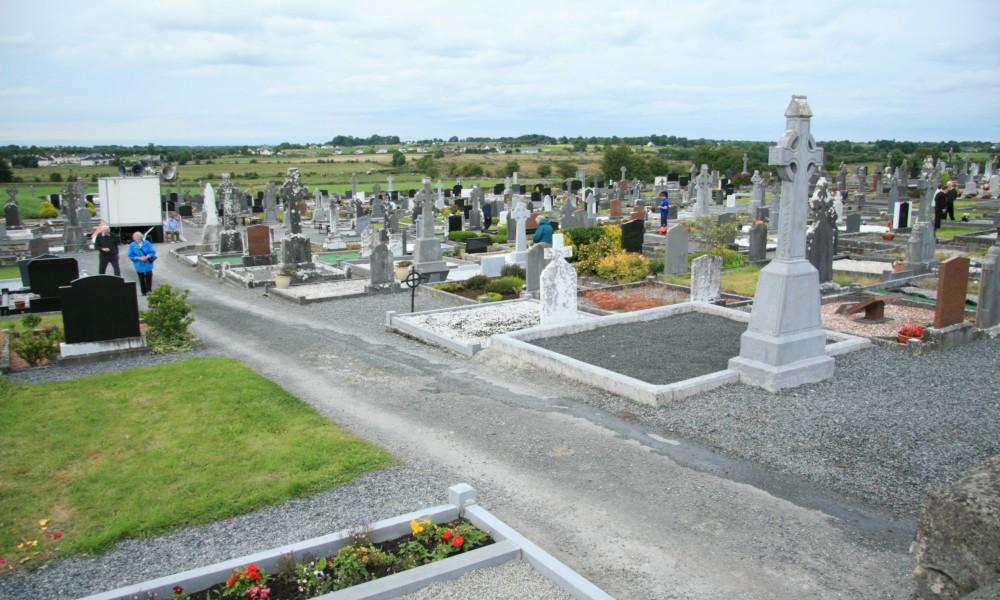
Athenry New Cemetary

Athenry New Cemetary image reference Athenry Parish Heritage Website


"Mr. P. Riordan J. P., presided on Saturday at a special meeting of hte Loughrea Rural
District Council, acting as a Burial Board, to consider a requisition signed by the Very Rev. Cannon Canton, P. P., Rev. R. P. Roe, Rev. T. H. Burkitt, Rev. E. F. McGough, C. C.,; Messers S. Taylor, J. P.;; C. Daly, P. Monaghan, T. Ruane, F. J. Finnerty, E. J. Fitzsimon's; J. Sweeney, P. Mahon, and T. HIggins, Athenry assessed for the relief of the poor within the district, to determine whether a burial ground should be provided at or near the town of Athenry; and whether for that purpose the Burial Board should purchase, or otherwise obtain from the Congested Districts Board portion of the lands of Boyhill, in the Athenry E. D.
It was resolved , on the motion of Mr. R. P. Nolan, seconded by Mr. P. McDonagh, to provide a new burial groudn for the town and district of Athenry, and that the Congested Districts Board be approached with a view to obtaining part of the lands of Boyhill for the purpose, and that the committee consisting of Messrs. R. P. Nolan, C. McDonagh, Cannon Canton, Rev. Mr. Roe, Mr.Burkitt, be appointedt o negotiate with the C. D. B. as to the terms of purchase, - Mr. Nolan said were it not for hte kindness of Rev. Mr. Roe, who gave them the sueo f the Protestant burial ground at Athenry, the people of the town anddistrict would have no place to bury their dead for considerable time" [sic]

Friday, October 12, 2018

World War I Unveiling by Eoin O' Neill


Image result for world war 1 1918
Reference: https://www.google.ie/search?biw=2277&bih=983&tbm=isch&sa=1&ei=rtLAW5bZPOuOgAb8jrqACg&btnG=Search&q=world+war+1+1918#imgrc=Y0Hfl5-EyQTrVM:


There will be an unveiling of a World War I memorial to the men who fought and those who died from Athenry Town and surrounds in the war. A total of 12 men from the locality tragically lost their lives. This will be held in the community park on Sunday November 11th at 12.30pm (after 11am mass).
All are welcome to attend espically those who had members of family who fought or who died in the Great War.
This is an opportunity for the community to come together and remember the sacrifice these local men gave for the freedom of small nations and the hope of achieving Home Rule in Ireland. For any more information please contact Eoin O' Neill at eoin7791@yahoo.co.uk.

Below is a list of men who fought in the Great War from Athenry. Are you a descendent of these WWI soldiers from Athenry. If so please contact Eoin O'Neill (e-mail in above paragraph)


LIST OF MEN FROM ATHENRY WHO DIED IN WORLD WAR I

12  NAMES
NAME                                    AGE               DATE OF DEATH

Fredrick.C.Hamilton                                    01/09/1914      Private 1st Irish Guards      Athenry                                 France


Robert.T.Kennedy                 38                    17/10/1914      Private 1st Irish Guards      Raheen, Athenry                                 France


John Creane                                                    03/02/1915      Private Conn Rangers 1st Batt Raheen, Athenry


Michael Fahy                          32                    07/06/1915      Private Conn Rangers 1st Batt Cartimore, Athenry      
                                          Mesopotamia

John Hegarty                                                   22/08/1915      Quartermaster Conn Rangers 5th Athenry    
                                                  Gallipoli

John J McCabe                                                25/09/1915      Sergeant Highland Light Inf 
Athenry     
                                             France

Michael Flaherty                                             13/04/1916      Private Conn Rangers 1st Batt Ballysker                                                        Mesopotamia


Edward Daly                            38                   03/11/1916      Private Conn Rangers 1st Batt Monivea                                                         Mesopotamia 


Thomas Donohoe                                           12/06/1917      Rifleman The London Regiment 
 Esker,Athenry                                                            London


Patrick Walsh                          29                    21/12/1917      Private Conn Rangers 6th Batt Athenry                                                          France


William Mannion                   22                    13/03/1918      Private Labour Corps        Athenry                                                    France

John Treacy                         24                    20/09/1918      Private South Irish Horse Athenry                                                    France

Saturday, September 15, 2018

Bridwells of East Galway 1828-1844 by Ronan Killeen

Since 2011, I have a  strong interest in criminality and law and order in Ireland for many years. In 2011 I completed his thesis on three cases of capital punishment in Galway, 1885-1923. This publication was orignally published by the South East Galway Archaeological and Historical Society where I have also written  about Law and Order in 19th Century Galway in our South East Galway Archaeological and Historical Society Summer 2016 issue, here I focus on the

‘Bridewells of East Galway’.

  As previously referenced, during the 18th century each county had its own prison located in the chief town of that county. The law also stated that every county would have a house of correction called a ‘bridewell’; where drunkards, petty thieves, rioters and vagrants were held before their trail albeit this could extend to years in exceptional circumstances. Lunatics were also sometimes kept in bridewells. 

 Notwithstanding the ‘Age of Enlightenment’, a period where many intellectuals believed that men were perfectible, the common view remained that those in the jail were wicked and deserved their punishment. The reformer, John Howard, was not one of those. As part of the reforms of the era, Inspectors were to visit prisons at least once a week and forward reports to the officer who was to be the apex of the system. All reports are referring to the bridewells in East Galway between the years 1828 to 1844 are now available.

 1828 Reports

 Gort: This prison is regularly kept. It contains only two small cells for males, and one room at the top of the house for females, with keeper’s rooms. It is not, consequently, what the law specifies as necessary for a sessions town bridewell. It is however kept clean, the poor prisoners are fed, and the keeper is a correct officer. The prisoners are frequently kept many days here without any written authority except for the first three days.

 Woodford: This is a clean neat little establishment, attended to by the keep in every respect. Very few prisoners are confined here, and I am unwilling to call upon the county to enlarge it. The yard should be divided; but the river runs so near to the prison that it is not necessary to sink a pump at present.

 Loughrea: This old prison remains in the same miserable state in which it has always been reported, and indeed now scarcely weather proof. The allowances to prisoners are however supplied, and the duties of local inspector effectually executed by the officiating clergyman. A presentment was made at the last assizes for erecting a new and sufficient bridewell for this populous town, and the site has been approved by the Inspector General.

 Tuam: This bridewell is devoid of all legal accommodation, but the grand jury have presented money at the last assizes to erect a new one. I waited upon the Archbishop of Tuam at my inspection.

1838 Reports

 Ballinasloe: This prison is quite unfit for use; and if a new prison should not be built, it would be quite inconsistent with the law to lodge prisoners in it.

 Loughrea: This is a sufficiently commodious bridewell; and every accommodation and allowance prescribed by law is afforded to the inmates; who are numerous.

 Woodford: This prison contains but two rooms for prisoners. There had been but an average of about 20 names in each quarterly return of committals; but from the imprisonment of drunkards, the number in the last return was 58, and an addition will become necessary.

 Gort: The presentment for a new bridewell at Gort having been made under a wrong Act of Parliament, it will be necessary to commence de novo under the provisions of the Prison Act. In consequence of this delay, some repairs have been ordered, which might otherwise have been inexpedient.

 Tuam: I found this prison in very good order; it contains sufficient accommodation, and is conformable to law. 

 Eyre Court: This prison contains the accommodation required by law, and is kept with regularity.


1839 Reports

 Ballinasloe: ‘We have for many years reported the illegal accommodation of this prison. There are but two small rooms and one yard. I found, on my inspection, the Males and Females together. The old and infirm Keeper is nearly bedridden, and the Prison is unsafe. It should be abolished as a place of confinement.

 Woodford: There are only two cells and one yard to this Prison. It is too small, and otherwise illegal, and an addition is intended. The plan will be laid before the Grand Jury at Spring Assizes, and we strongly recommend its adoption. The keeper is an old man, but attentive to his duty.
16
The Inspector General’s  report on The Prison’s of Ireland 1839 incorporates the Loughrea, Eyrecourt, and Tuam Bridewells all under one heading 

Gort
As a new and legal Bridwell is building in this Sessions town, it is unnessary to remark on the old
and inneffecient place of  confinement. The Keeper is a steady and attentive Officer.

 
Loughrea, Eyrecourt, and Tuam Bridewell’s 1839 (are all incorporated as one inspection)
  These three small prisons for temporary confinement previous to removal to the County Gaol, are all new, and contain 2 day rooms; 2 yards; and 7 cells each, with keeper's apartments. They are correctly attended to by the Keepers, the registries carefully kept, and the pauper Prisoners are fed. A supply of a few pairs of blankets are required in each; and the roof of Tuam Bridewell requires repair.


1842:  

Loughrea "This bridewell was cleanly and kept in very good order. It required whitewashing and I suggested changes in ventilation. The mixed diet are used, at a daily cost of 4d.exclusive of fuel expense. The registry and accounts were accurately kept. This bridewell is scarcely ever without a prisoner. The local inspector visits this as well as other bridewells and the practise is attended with very good results (quite a change from 1828 report).

1844 report 

 In this Inspector General’s report of The Prisons of Ireland 1844 all the Bridewell’s of Ballinasloe, Eyrecourt, Gort, Tuam, Loughrea, Woodford, Oughterard, and Clifden are now all incorporated.
 

He writes ‘I inspected these bridewell’s, and found they were all in a very creditable state of order and repair, which is to be attributed to the great care and attention which is paid by the Local Inspector, Rev. Mr. D’Arcy, to this department. He makes periodical inspections, and reports regularly to the Board of superintendence.

In fact, the system which has been established by the prison authorities in this county, is so admirable with respect to the general superintendence and surveillance of these minor prisons, that is worthy of adoption in other counties.

Woodford and Eyrecourt bridewell’s are under extensive alterations, and I have no doubt they will be made very efficient establishments. These two latter buildings were about to be abolished altogether, but it appears that they could not be dispensed with, being situated in extensive and populous districts.

All accounts have been taken from the Prison’s of Ireland Reports of the Inspector General on the General State of The Prisons of  Ireland in the years of 1828; 1838; 1839; 1842 and 1844.

Saturday, May 26, 2018

Elopement in County Galway by Ronan Killeen

Back in 2013 i printed of a newspaper article from the 19th century it was to do with an 'Elopment'

'Elopment in the County of Galway'

'About three o'clock a.m. on Monday morning, the 27th inst., the inhabitants of the little village of Athenry, Co. Galway, were disturbed from their slumbers by the sound of a carriage wheels driving rapidly over the shingled road and balting at the hotel door.
Presently a loud knocking announced that the parties required admittance. The waiter instantly obeyed the summons,  and the inhabitants of the carriage were ushered in. Fifteen minutes scarcely elasped when a car drove up in hot pursuit, and it became known that Mr. _______, of Castlebar, had eloped with a daughter of the late Captain  _______ of County Mayo.
The car contained her brothers who immediately demanded their sister, which was refused. Pistols were recalled into requistion, and were it not for the timely interference of H. M. McCormack, Esq., S. I. (Sub - Inspector), and a party of police the consequences may have been serious.
The lady, who is only eighteen years of age, and has a large fortune in her own right, refused to leave her partner of her flight.
However, she at last consented, and so the matter rests for the present. The young cavalier having lost his fortune, and being the worse for taking much (of?) the 'native' to drown his sorrow, got into a row with the postmaster who  inflicted on him a severe castigation. The materr will come before the magistrates at petty sessions 

                            Correspondent of Saunders. 

Saturday, April 14, 2018

A Selection of Holy Wells in East Galway: Lady's Well, Athenry; St. Dominic's, Esker and Tobar Crónán, Ballymana, Craughwell by Ronan Killeen


Above: Lady's Well, Athenry, Co. Galway (author's collection)


Some Holy Wells near Athenry

 From earliest times, Irish people have believed in the healing powers of sacred well waters. In fact, religious cults associated with water date back to the Late Bronze Age. Though holy wells appear to be Christian monuments, many rituals including special days to visit wells and leaving gifts like coins in appreciation display strong pre-christian elements.
 Nowadays, most locals frequently light candles and recite the rosary while walking around the wells referred to as ‘doing the rounds’.

While all of us cherish our local heritage, in truth there are as many as three thousand holy wells throughout Ireland which were / are used for religious pilgrims, or visited for cures of ailments. In his book, Holy Wells in Ireland, the historian Patrick Logan demonstratesthat the custom of visiting the wells is likely very old, and in many cases confirms pre-Christian in origin.
The custom of leaving offerings is just as old e.g. in Lady’s Well (Athenry) votive offerings such as medals and rosary beads surround the statue of the Immaculate Conception to this day.

Logan highlights that the ‘Custom of visiting holy wells is mentioned in our oldest literature. There is the reference to the healing well which was prepared by the legendary physician of the Irish, Dian Cecht, and was used by him to treat the wounded at the Battle of Moyture.
Chritianised version of archaic stories about these wells can be found in the ‘Lives of the Irish Saints’, generally written before the thirteenth century. Types of plantation regularly found nearly holy wells are whitethorn, hazel, ash, and formerly oak, but holly, rowan and yew are also found near wells. In a few cases the ‘well’ is found in the stump of a tree.’

At one time the Catholic Church did not approve of pilgrimages to holy wells, but this attitude changed over time with some holy wells still known for curing eyesight or the senses. In truth, a virtual industry for the church was build around some sites.
According to Logan – the pilgrimage of the holy well generally took place between the 15th of August and 1st of November, and when seeking a cure or making any special request, people visited them three times. One of the senses to be cured by the holy wells was the eyes which may have been due to people living in smoky cabins creating inflammation of the eyes.


Lady’s Well, Athenry

This is one of the most famous wells in the county. Interestingly, according to the archaeological survey the well is located at Baunmore GA084-02200. However to many of the people in the Athenry locality and google search of location of the well is located at Kingsland/Kingsland South.
Reviewing the ordance survey map of 1883-1913  there is well called Toberblanra (see image below) is well there just at  tip of Baunmore townland and the entrance today  is a the Kingsland side.

However, some of the Ordance Survey maps may not be right e.g. on one of the 19th Century O. S. maps one of the town gates the Spittle Gate shows it is located North West of the town (up by Brady's field opposite the Roman Catholic church St. Mary's Church of the Assumption, Athenry) when the Spittle Gate is actually located opposite Joyces Shopping Centre beside the apartment blocks. It would make an interesting historical geographical discussion on proper locations of monuments in Galway at some stage.


The date for the Marian apparition there is generally given as 15 August 1249 (though clearly we do not have any formal documentation to substantiate this claim). There was firsty the ancient tradition that the this event took place on the 15th August after ‘The Battle of Athenry’, and secondly an ancient account in the Annals of Iar Connacht that a major battle took place in Athenry on 15 August 1249. This battle is not to be confused with the later and more famous Battle of Athenry which was fought on 10 August 1316.

The annals record that the Normans, within the town, beseeched the attacking Irish not to dishonour the feast by attacking on that day. The Irish did attack and were defeated. Tradition / legend states that the Marian apparition appeared to some of the defeated soldiers as they were retreating from the battle. We can be quite certain that the promotion of Marian devotion would have been a very important priority for the New Dominican order whose Priory had just been built in the town (1241) since their founder Saint Dominic (1170-1221) was a great apostle of the Rosary.

At least two monuments at the well date from the medieval period. While one cannot be certain that the well was the original location for either of these, the fact that they have been located at the well for at least three centuries shows a continuity of the tradition honouring this location as a place of prayer.
Firstly, the Celtic Pieta, which at present is set in the outer wall of the well, dates from the 14th century. Until the recent renovations it was placed in the inner corner where the statue now stands. It is unlike the continental pieta in style as the mother holds the body of the dead Christ not cradled in her arms, but in an almost upright position and tradition here suggests that it was defaced by soldiers during the Cromwellian Wars. Secondly, the ‘Headache Stone’, a large rectangular stone with the cavity in the centre was a socket for a medieval cross. There is a very strong tradition of personal healing associated with this stone.

In summary, this well has been a major centre of pilgrimage for generations. In the last century it was a place of pilgrimage for people from all over Southern Connemara who came in thousands each 15th August. While devotion to the place weaned somewhat in the 1950s and 1960s, it was always a place of prayer for the people of Athenry and in recent years is growing again in popularity. There is also a pilgrimage on 8th September but this tradition is not as popular as that of the 15th August.

Saint Dominic's Well, Esker 


St. Dominic's Well, Esker, Athenry.

There are very many wells in Ireland dedicated to Saint Dominic. One such well dedicated to Saint Dominic is located at Esker Monastery which was founded in the 18th century after the Dominican Order were evicted from the Athenry Dominican Priory (monument number GA096-174, Esker townland). According to the Esker Monastery Booklet, it is a powerful spring at the foot of the 200 ft. high Dominican Hill.

At midday on the January 5th, there is a vigil of the Epiphany with water from the well put into a stone trough and blessed with the ordinary blessing of holy water. For those interested in detail of their own holy wells, look no further than the 1937 national school’s folklore. Extracts from the www.duchas.ie website of the children in Presentation Convent National School for example provides considerable detail on the wells in Athenry. Tobar Crónán Mannin townland (GA104-198). O’Donovan (1838) confirmed that stations were ‘performed at this well’.

Tobar Crónán, Ballymana, Craughwell, Co. Galway

Mannin townland (GA104-198). O’Donovan (1838) confirmed that stations were ‘Performed at this well’. In the early to mid nineteenth century. The following is the folklore detail on the holy well from the school’s folklore (Written by; Nora Ballanan, Mannin with Information obtained from Nora Connolly, Mannin.). Below also is the 1840 OS map with the well in the south-east of same.

Above: OS Map of the location of Tobar Crónán, courtesy of the South East Galway Archaeological and Historical Society.

'In the parish of Ballmana, a holy well is situated. It is called Tobar Crónan. Tradition has it that this was once a holy well, and several people were cured. It is sheltered on either side by hawthorn bushes and ash trees. The water is pure spring and holds its depth in winter and summer. It is also surrounded by numerous rocks some of a huge size. The water rises beneath the bushes and forms into a pool. Then it gradually expands itself and at length flows, and forms a stream. After about half a mile of a course it adjoins the well in two but nobody seems to interfere with the water on the upper side. It is believed the water would not boil, but nobody tampers with it. The water which flows through the wall supplies the inhabitants of the village, and in summer, people travel several miles to obtain some. It is said to be one of the finest wells in the county. No fish us ever seen in this well, but it is covered over with water - cress.'.


I have written about the Bureau of Military History 1913-1921 one before but I am adding more content in this article. An aspect of oral ...