Friday, September 20, 2019

Athenry and the Irish Civil War (Revised 2019) by Ronan Killeen

I would like to thank South East Galway Archaeological and Historical Society for publishing and editing this article.

On the 6 December 1921, the Anglo-Irish Treaty was signed bringing the 'Free State' into being, ending the Irish War of Independence with Britain, but also provoking bitter disagreement in Ireland itself. By the beginning of 1921, Athenry had come under the control of the National Armed Forces. However, trouble was brewing and soon the Superintendent and the Staff of the Agricultural College were forced by Irregulars – those opposed to the Treaty – to blockade the road a few miles from the town. This was just the beginning of unrest in the region.

Athenry Irregulars
The first major disturbances involving Athenrymen came in September 1922 when a party of troops under Brigadier Callinan and Captain Thompson arrested five men in Tarramid, Clarinbridge, and compelled them to clear the roads in the district. The men had been arrested for holding illegal ammunitions and had also been prominent in blocking roads but were released on giving the usual undertaking. The names of these ‘Irregulars’ were William Kelly, Coldwood, Athenry; William Commins, Coldwood, Athenry; Thomas Holland, Derrydon-
nell, Athenry; Michael Freaney, Derrydonnell, Athenry and John Hynes, Clarinbridge.

First Fatality
The first fatality came on Sunday 1 October 1922 when a member of National Armed Forces, Corporal Stephen Diviney who came from the Oranmore District, was walking home from a dance in Payne's Hall. En route, he came across two raiders who had just fired shots into two shops belonging to Messrs Broderick (C. L. Brodericks Chemist).

According to the Connaught Tribune, ‘Before 11 p.m. most people were in their houses or at the dance, either two or four men, who are said to have been armed with rifles, discharged a number of armed rifles, discharged a number of shots into Messrs. Brodericks chemist shop and also into a public house owned by the same family’... then came the shooting. Corporal Diviney came across the men and was demanded to halt by the raiders but thinking it was his own comrades he said 'It is all right boys' but was then shot'.

The site of the former Payne's Hall where Corporel Stephen Diviney attended a dance before leaving to be tragically shot.
After the shot to the heart, Diviney fell into a pool of his own blood and died within a few minutes. This was the first time during the Civil War that blood had been shed in the Athenry area. The National Troops immediately came out onto the streets, searched all likely hiding places, and went to the show grounds and adjoining fields. Thirteen men were arrested and marched to Galway Jail. The men that were arrested included C. Daly, P.J. Daly, T.J. Daly, M. Ward, M. Kelleher, J. Clancy, Stephen Jordan, T. Regan, and J. Regan.

Kelly's chemist/ Fields of Athenry Gift shop was formely C. L. Broderick's where the
raiders who shot Corporel Stephen Diviney 

Dr Crowley, coroner for South Galway, opened an inquest the following Monday. Medical evidence was to the effect that Diviney died as a result of a bullet entering the chest over the head. Confirming initial reports, the Galway Observer on the 14 October 1922 reported ‘Sergeant Thomas Creaven, who was in company with deceased, stated that they left the dance together, and that when near the post office saw two men in front of them.

One of the men shouted 'halt' and fired immediately. The bullet struck Corporal Diviney, who advanced a pace, and then fell on his back. The shot followed immediately after the cry of 'halt'.
In charging the jury, the coroner said it was a callous act to shoot a man because he was wearing the uniform of the National Army. The jury brought in a verdict that the deceased met his death from the effects of bullet wounds willfully inflicted by some person or persons unknown.

Armed Raids

Also in October 1922 there was an armed raid on the residence of Mr Joseph Meldon of Coolarne House. The raiders seized a mare, poney and trap, a set cart harenesses, cross-cut saws and other articles. Later that month six members of the Irregulars forces surrendered arms and ammunition at Athenry Military Headquarters. They also signed an undertaking not to take part in any further activities.

Railway Attacks
The railway bridges were also ‘victims’ of Athenry’s Civil War. In August 1922 the Athenry and Ballyglunnin railway bridge was blown-up, and days later the Athenry  to Tuam railway line was damaged.
In October 1922 the Athenry to Limerick train was fired at, but there were no casualties. In November 1922 the Athenry to Tuam bridges were blown-up again, and signal cabin at Ballyglunin was burned to the ground and the goods train was 'held up'.

Archbishop Criticism
On the 2 March 1923 Archbishop Dr. Gilmartion of Tuam made references to the immortality and crime on his visit to Athenry – We know that a first condition of serving God is to keep his commandments; and yet men daily dare to float his commandments. The commandments are not a tyrannical yoke. They only prescribe that what is necessary for the well being of the individual and the stability of society. 'Though shall not steal'- If that commandment was not made by God, it should be made by every form of civil government. 'Though shall not kill' - If that commandment was not made by God, it would be one of the first laws enacted by every state. In fact the fundamental duty is to protect life and property. Now these two commandments are generally accepted by pagans. But how are they observed by Christians? Or, to bring things nearer home, how are they observed by the Irish Catholics? Thirty years ago a murdered in Ireland would fill the whole nation in horror. Today it is commonplace...’.

More Raids
On the 5 August 1922 the Irish Times reported that 'Two houses had been raided in Ballygurrane, Athenry, and half a dozen boys, arming themselves with a pitchfork and a single shotgun with one cartridge, lay in ambush for the raiders the following night. They duly arrived. The single cartridge was exploded, 'hands up' was called from each side of the road, and the raiders found themselves with the fork prongs around there throats. They were deprived of their weapons and were marched to the Railway Hotel, Athenry, where they were handed over to the National Troops’.


1923
The strife continued into 1923. The ‘Munster and Leinster’ Bank was robbed by two men Joseph O’Rourke, a servant boy from Ardrahan, and Michael Murphy, a farmers son from Garragh in Gort (Authors note: Conflicting details of Murphy's address appear in the newspapers of the time).

Murphy had been with the Irregular IRA at the Renmore Depot, Galway before it was burned.
Initially after the robbery the raiders disappeared down the street. A shopkeeper, Miss McLoughlin, was after finishing her dinner next door and had seen the raiders enter the bank. She soon realised that the door between the shop and bank had been locked against her, and the two raiders escaped.

Then, after several ‘near misses’ and a catalogue of errors by authorities the men were eventually captured. On the 31 May 1923, the Freeman’s Journal reported that; ‘Michael Murphy, Ardrahan, Co Galway and Joseph O’Rourke, Coxtown, Ardrahan, Co Galway were tried before a military tribunal at Tuam on 24th day of May 1923.

 On charge of taking part in an armed robbery, in that they did, on 22nd May 1923 stole from the Munster and Leinster Bank, Athenry, Co. Galway in Tuam Military Barracks.’ The condemned men admitted their guilt but had stated that it was of no political significance and they were forced agents in connection with the land trouble. The night before their execution Rev. Father Cunningham,
who was the army Chaplin stayed with the prisoners and the following morning attended mass and received Communion. On the 31st May 1923 the prisoners were blindfolded and executed at 8am that morning.

Summary
These, and indeed other events in the Athenry area during the Civil War generated extremes of bitterness that have also haunted political life up to the present. While Athenry was spared the worst of the bloodshed, even today any further reference to, or more specific details on, the events and personalities locally could bring only division.

The opportunity to create a new society was set-back generations by the conflict. Approaching a cen-
tury on, we may finally be in a position to discuss the era openly and objectively.

Sources:
Waldron, Kiernan, Archbishops of Tuam (Nordwall Books 2008).
Corona, Guiomar Gonzalez, The Catholic Church in the Irish Civil War, (Cultivalibros, 2008).
Freeman’s Journal, 31/05/1923.
Irish Independent, 24/05/1923.
Irish Times Archive June 1922-May 1923.
Tuam Herald, 26/05/1923.
Southern Star, 26/05/1923.

Monday, September 16, 2019

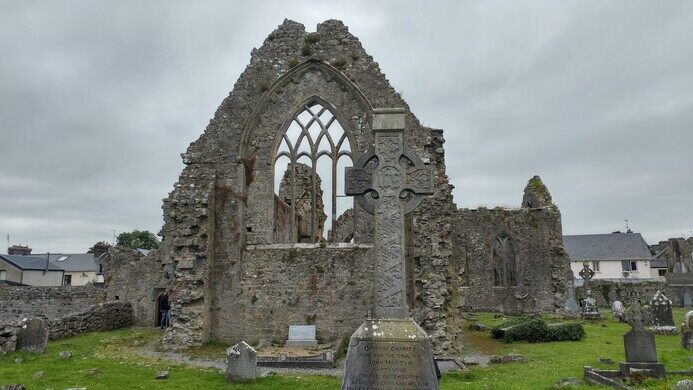
Some Surnames in Athenry Dominican Priory by Ronan Killeen & Adrian Martyn

Image result for athenry dominican priory
Reference: Image got from Atlas Obscura


The Athenry Dominican Priory graveyard is an interesting piece of our genealogical history, containing graveslabs of Brennan, Nolan, and Higgins families.
     Most Brennans in Co. Galway descend from an Ó Branáin lineage from Killogilleen parish. One in Athenry reads: Pray for the soul of Mary Brennan who departed this life on the 30th October 1867 at an advanced age Erected by Mrs. Bodkin Annagh as tribute of respect for great worth and long and faithful services.
 Lios Uí Uallacháin/Lisnolan, Manulla parish, Co. Mayo, was the home of a Nolan lineage, who by the 1490s were goldsmiths living in Galway town. Their coat of arms can be spotted in Kilkenny shop on High street. The graveyard features one inscribed 1858 Erected by Patk Nolan in memory of his father Thos Nolan who died Aug  1831 age 89 years and his wife Pinny.
     The Ó hUiginn lineage of Meath migrated to Co. Galway before the 16th century. A Higgins graveslab reads: Sacred to the memory of the ALICE HIGGINS wife of THOMAS HIGGINS who departed this life on the 10th day of March 1811 this was erected by Him in memory of her and his posterity may she rest in peace.  


Blackall and McDonagh by Ronan Killeen


Image result for blackall and mcdonagh athenry
Above: Left of photograph Blackall & McDonagh, St. Mary's Collegiate Church (now the Athenry Arts and Heritage Centre)  and Blackall and McDoangh (another store?) . The photo was taken from www.flickr.com


The earliest mention of Blackall which is referenced in the Freeman's Journal on the 4th May 1863 is a Charles Blackall:

'Lieutenant General Hall, C. B, of Knockbrack, with that liberality which always characterises him, has given orders to Charles Blackall of Athenry, to supply every tenant on his extensive estates (who may require it) with as much meal as will supply thier wants till the next harvest. The gallant general's liberality will be the more thought of when we state that many of the parties so relieved are three half gales of rent in arrear' 

C. Blackall is mentioned as an agent for Athenry under the headline IMPORTANT TO FLOCKMASTERS in the Drogheda Conservative 27th May 1865 'Athenry...C. Blackall'.'

Charles Blackall, Athenry is advertised selling Phospho Gauono to the Purdon, Brothers, Dublin, Geo. Segrave & co. Liverpool which is advertised in the Tuam Herald Saturday 27th April 1867.

In the Freeman's Journal on the 28th March 1901 there is an advert by Blackall and McDonagh looking for a 'Young man wanted for Boots and General Drapery, apply stating references and salary required to Blackall and McDonagh, Athenry'


Blackall and McDonagh's were local agents for 'Skin Diseases in Horses and Dogs use for Equisan according to the Westmeath Independent 1st March 1902.


Tuesday, August 20, 2019

Athenry Women in the British Red Cross by Ronan Killeen

Image result for irish women british red cross world war 1
Volunteers of the British Red Cross (image got from Brisith Red Cross website)

The red cross originated in 1863 by a Swiss businessman Henry Duant. Who was devasted by the several casualites of the Battle of Sioferino 1859 because many people due to lack of care.

 He proposed creating national relief societies, made up of volunteers, trained in peacetime to provide neutral and impartial help to relieve suffering in times of war.

In response to these ideas, a committee (which later became the International Committee of the Red Cross) was established in Geneva. The founding charter of the Red Cross was drawn up in 1863.

When war broke out between France and Prussia in July 1870, Colonel Loyd-Lindsay (later Lord Wantage of Lockinge) wrote a letter to The Times. He called for a National Society to be formed in Britain just like in other European nations.

The British National Society for Aid to the Sick and Wounded in War was formed. It gave aid and relief to both warring armies during the Franco-Prussian War and in other wars and campaigns during the 19th century. This was done under the protection of the red cross emblem.

Recently, records of Athenry women in the British Red Cross were released on line see link https://vad.redcross.org.uk/Search?hosp=athenry+&fbclid=IwAR3Bh7G-w1Vl7UR5EGHjxwOJ5ffM3gh9dUx-ce7SuVWY077h8pA2kO5rNJ8

The Athenry women involved in the British Red Cross were Norah T. Burkitt, Linda Laura Jurd, Dorethy Noelle Lopdell, Leilla S. Lopdell, Zeile Marguerite Lopdell, Theta W. F. Moon; Alice De Mowbray, Amy Roe and Anna Helen Kathleen Roe.

Saturday, August 10, 2019

Lady's Well, Athenry 1923-1924 by Ronan Killeen

Lady's Well, Athenry (reference: Athenry Parish Heritage page)


In August 1923  supporters of the then present government (Free-State) and anti-treaty attend the pilgrimage at Lady’s Well, Athenry. Patrick Kennedy presided over the meeting of Treaty candidates was held in the afternoon. Stephen Jordan presided the Anti-Treaty gathering addressed by Mr. O’Dea. A statement made by the chairperson aroused hostility in the crowd and a tussle ensued. Some of the crowd panicked and fled the scene only to return later. The Civic Guard entered the crowd and drew their batons using them vigorously.  The disturbance was quelled and Mr. O’Dea was able to resume his speech.[1]
The above event happened after a ceasefire for the Irish Civil War was called in May 1923 conflict was still high between Treatyites  and Anti-Treatyites.
The Civic Guard was formed by the Provisional Government in February 1922 to take over the responsibility of policing the fledgling Irish Free State. It replaced the Royal Irish Constabulary (RIC) and the Irish Republican Police of 1919–22.
In the year of 1932  which was the same year of the Eucharistic Congress
there was a public meeting held at Lady's Well which  authorised a ladies committee to collect funds in Athenry  for the purpose of erecting a Memorial Cross at Lady's Well which was to be erected on 26 June 1932 for the Eucharistic congress. That same year Fr. Conroy P. P. organised times for masses for pilgrims visiting the well as visitors that arrive in Athenry at different times such as morning, evening by train and put an appeal to pilgrims to reply in his letter  via the Connacht Tribune suitable times for them.  '[2]
In August 1934 the Connacht Tribune reported that a ‘A big crowd attended arrived Tuesday evening and Wednesday morning . The Wednesday morning train was crowded with pilgrims from Connemara and the Claddagh, Galway. Some years ago an all-night vigil at the well-used to precede Lady day, very few keep the vigil visits on the evening of the 14th and 15th.’


[1] Freeman’s Journal 16/08/1923
[2] Connacht Tribune 13/08/1932

Monday, December 17, 2018

List of Publicans and Hotel Owners/Managers 1856-1936 by Ronan Killeen (Merry Christmas!)


1846[1]
Margaret Barrett, (Hotel and Posting House); Matthias Cannon; John Dunleavy; John Holleran; John Whelan.

1856[2]
Margaret Battett (Hotel and Posting House); William Brown (Railway Hotel); Bridget Cannon; John Dunleavy; John Holleran; Timothy Kinneen (Hotel); Bridget Whelan.

1870[3]
Ann Barrett; Blackhall and McDonagh; Mary Dermody; Thomas Donohue; John Dunleavy; Morgan Fahy; Ann Gunning (Hotel and Posting House); Thomas Heavy; Michael Higgins; James Joyce; Bridget Kelly; Hector McCoy; Michael Nolan; Railway Hotel and Posting House; Timothy Kinneen; James Ryan; Bridget Whelan.


1881[4]
Joseph Barrett; Blackhall and McDonagh (trading in wine spirits may not have been publicans?); Michael Broderick; James Cloonan; John S. Dillion; Patrick Dooley; Patrick Dunleavy; Morgan Fahy; Peter Joyce; Bridget Kelly; Thomas R. Kelly; Patrick Kinneen; Kinnen’s Hotel (also posting house); Timothy Kinneen; Lawerence Lardner; Bernard Nolan; Richard Nolan; Anne Kavanagh (Railway Hotel); James Ryan; Samuel Smyth; Joseph Sweeney; Bridget Whelan.

1901[5]
Maud Josephine Kennedy (Hotel Business and Proprietress) ; Michael J. Lardner; Bridget Lardner; John J. Glynn[6]; Thomas Duddy; Richard P. Nolan; Peter Ruane; Patrick Fox; Patrick J. Nolan; John P. Gill; Honoria Nolan; Michael Ruane; Matthias McDonagh; Matthew Daly.

1911[7]
Maria McMery, Hotel Mangeress, Cullairbaun; Margaret Whelan; Bourkes Lane (Burkes Lane but Bourkes in 1911 census); Bridget Lardner is not listed as a publican in 1911 census however her son Lawerence Lardner is a Publican’s Assistant; Patrick Mahon is now a publican but was a Grocer and Emigration agent in 1901 census; John Franicis Kelly, Cross street; Francis Joseph Finnerty, North Gate Street; Mary Ruane, North Gate Street; Mary Ryan, North Gate Street; Peter Ruane, Old Church street, Mary Daly, Hotel Mangeress, Iug Hotel (Ivy Hotel spelling wrong in 1901 census?); Old Church street.

1931[8] and 1936[9]
Corbett and Co., Northgate Street; Thomas Curran, The Square; M. Daly, Cross street; Patrick Duffy, The Arch; E. Durkin, Church street; Mrs. Fallon, Northgate street; P. J. Fox, Old Church street; J. Glynn’s, Old Church street; Thomas Higgins, Davis Street; Stephen Jordan, Davis street; J. F. Kelly, Cross street; M. R. C. V. S.,(see footnote below referring to M. R. C. V. S.)[10] , Church street, P. Mahon, Cross street; Patrick Mahon, Bridge street;  Mrs. Nolan, Northgate street; R. P. Nolan, Old Church street; Mrs. O’Neill, The square; D. Reynolds, Old Church street.

 ..................and also Merry Christmas all and happy new year!


[1] Slater’s directory 1846
[2] Slater’s directory 1856
[3] Slater’s Directory 1870
[4] Slater’s occupation directory 1881
[5] 1901 census
[6] J. Glynn’s but  written down as John J. Glynn on 1901 census.
[7] 1911 Census
[8] http://www.from-ireland.net/1931-trade-directory-athenry-galway/
[9]  Thom’s Directory 1936
[10] M. R. C. V. S.  = Member of the Royal College of Veterinary Surgeons in the occupation directory from 1931 but I believe this may have been a mistake as  M. R. C. V. S. dosen’t appear in the occupational directory source of Thom’s directory 1936 but the only M.R. C. V.S. refered to was a T. Kelly McDermott based in Raheen Athenry. From Thom’s Directory 1936


Tuesday, November 13, 2018

ATHENRY NEW CEMETARY 5TH JUNE 1915 CONNACHT TRIBUNE EXTRACT by Ronan Killeen


Athenry New Cemetary

Athenry New Cemetary image reference Athenry Parish Heritage Website


"Mr. P. Riordan J. P., presided on Saturday at a special meeting of hte Loughrea Rural
District Council, acting as a Burial Board, to consider a requisition signed by the Very Rev. Cannon Canton, P. P., Rev. R. P. Roe, Rev. T. H. Burkitt, Rev. E. F. McGough, C. C.,; Messers S. Taylor, J. P.;; C. Daly, P. Monaghan, T. Ruane, F. J. Finnerty, E. J. Fitzsimon's; J. Sweeney, P. Mahon, and T. HIggins, Athenry assessed for the relief of the poor within the district, to determine whether a burial ground should be provided at or near the town of Athenry; and whether for that purpose the Burial Board should purchase, or otherwise obtain from the Congested Districts Board portion of the lands of Boyhill, in the Athenry E. D.
It was resolved , on the motion of Mr. R. P. Nolan, seconded by Mr. P. McDonagh, to provide a new burial groudn for the town and district of Athenry, and that the Congested Districts Board be approached with a view to obtaining part of the lands of Boyhill for the purpose, and that the committee consisting of Messrs. R. P. Nolan, C. McDonagh, Cannon Canton, Rev. Mr. Roe, Mr.Burkitt, be appointedt o negotiate with the C. D. B. as to the terms of purchase, - Mr. Nolan said were it not for hte kindness of Rev. Mr. Roe, who gave them the sueo f the Protestant burial ground at Athenry, the people of the town anddistrict would have no place to bury their dead for considerable time" [sic]

Friday, October 12, 2018

World War I Unveiling by Eoin O' Neill


Image result for world war 1 1918
Reference: https://www.google.ie/search?biw=2277&bih=983&tbm=isch&sa=1&ei=rtLAW5bZPOuOgAb8jrqACg&btnG=Search&q=world+war+1+1918#imgrc=Y0Hfl5-EyQTrVM:


There will be an unveiling of a World War I memorial to the men who fought and those who died from Athenry Town and surrounds in the war. A total of 12 men from the locality tragically lost their lives. This will be held in the community park on Sunday November 11th at 12.30pm (after 11am mass).
All are welcome to attend espically those who had members of family who fought or who died in the Great War.
This is an opportunity for the community to come together and remember the sacrifice these local men gave for the freedom of small nations and the hope of achieving Home Rule in Ireland. For any more information please contact Eoin O' Neill at eoin7791@yahoo.co.uk.

Below is a list of men who fought in the Great War from Athenry. Are you a descendent of these WWI soldiers from Athenry. If so please contact Eoin O'Neill (e-mail in above paragraph)


LIST OF MEN FROM ATHENRY WHO DIED IN WORLD WAR I

12  NAMES
NAME                                    AGE               DATE OF DEATH

Fredrick.C.Hamilton                                    01/09/1914      Private 1st Irish Guards      Athenry                                 France


Robert.T.Kennedy                 38                    17/10/1914      Private 1st Irish Guards      Raheen, Athenry                                 France


John Creane                                                    03/02/1915      Private Conn Rangers 1st Batt Raheen, Athenry


Michael Fahy                          32                    07/06/1915      Private Conn Rangers 1st Batt Cartimore, Athenry      
                                          Mesopotamia

John Hegarty                                                   22/08/1915      Quartermaster Conn Rangers 5th Athenry    
                                                  Gallipoli

John J McCabe                                                25/09/1915      Sergeant Highland Light Inf 
Athenry     
                                             France

Michael Flaherty                                             13/04/1916      Private Conn Rangers 1st Batt Ballysker                                                        Mesopotamia


Edward Daly                            38                   03/11/1916      Private Conn Rangers 1st Batt Monivea                                                         Mesopotamia 


Thomas Donohoe                                           12/06/1917      Rifleman The London Regiment 
 Esker,Athenry                                                            London


Patrick Walsh                          29                    21/12/1917      Private Conn Rangers 6th Batt Athenry                                                          France


William Mannion                   22                    13/03/1918      Private Labour Corps        Athenry                                                    France

John Treacy                         24                    20/09/1918      Private South Irish Horse Athenry                                                    France

I have written about the Bureau of Military History 1913-1921 one before but I am adding more content in this article. An aspect of oral ...